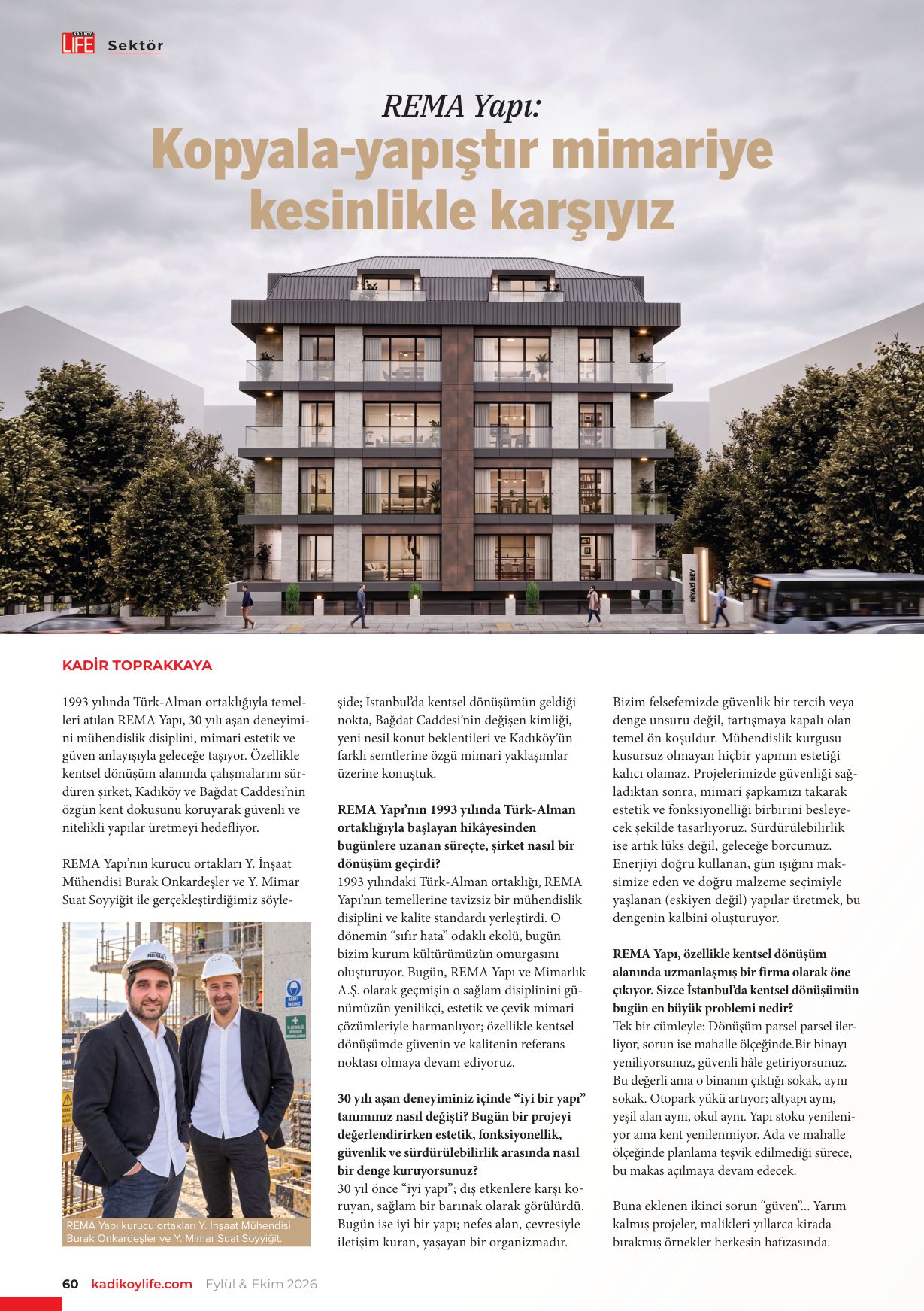
Founded in 1993 as a Turkish-German partnership, REMA Yapı carries more than 30 years of experience into the future with engineering discipline, architectural aesthetics and a commitment to trust. Working mainly in urban transformation, the company aims to produce safe, high-quality buildings while preserving the distinctive urban fabric of Kadıköy and Bağdat Avenue.
In our conversation with REMA Yapı’s founding partners, civil engineer Burak Onkardeşler (MSc) and architect Suat Soyyiğit (MArch), we talked about where urban transformation in Istanbul stands, the changing identity of Bağdat Avenue, the expectations of new-generation home buyers and the architectural approaches specific to Kadıköy’s different neighbourhoods.
REMA Yapı’s story began in 1993 as a Turkish-German partnership. How has the company transformed since then?
The Turkish-German partnership of 1993 built an uncompromising engineering discipline and quality standard into REMA Yapı’s foundations. The “zero defect” school of that era is still the backbone of our corporate culture today. Now, as REMA Yapı ve Mimarlık A.Ş., we blend that solid discipline of the past with today’s innovative, aesthetic and agile architectural solutions, and we continue to be a reference point for trust and quality, especially in urban transformation.
How has your definition of a “good building” changed over more than 30 years? How do you balance aesthetics, functionality, safety and sustainability when evaluating a project today?
Thirty years ago, a “good building” was seen as a solid shelter that protected you from the outside. Today, a good building is a living organism that breathes and communicates with its surroundings.
In our philosophy, safety is not a preference or something to be balanced; it is a non-negotiable precondition. No building whose engineering is less than flawless can have lasting aesthetics. Once safety is secured, we put on our architect’s hat and design aesthetics and functionality so that they feed each other. Sustainability is no longer a luxury; it is our debt to the future. Producing buildings that use energy wisely, maximise daylight and, thanks to the right materials, age gracefully rather than wear out — that is the heart of this balance.
REMA Yapı stands out as a company specialised in urban transformation. What do you think is the biggest problem of urban transformation in Istanbul today?
In one sentence: transformation proceeds plot by plot, while the problem is at the scale of the neighbourhood. You renew a building and make it safe. That is valuable, but the street it opens onto is the same street. Parking demand grows, yet the infrastructure, green space and schools stay the same. The building stock is renewed, but the city is not. As long as planning at the block and neighbourhood scale is not encouraged, this gap will keep widening.
The second problem is “trust”. Everyone remembers unfinished projects and owners left paying rent for years. That is why the hardest part today is not the technical work but persuasion. We believe the only way to solve this is concrete assurance: bank financing guarantees and letters of guarantee. Until the owner’s risk is brought to zero, signatures don’t come and delays don’t end.
The third is the gap between expectations and costs. While costs move with exchange rates and inflation, expectations for the sharing ratio are frozen in the conditions of the previous decade. Until that gap closes, many plots stay where they are.
Bağdat Avenue and its surroundings hold an important place in REMA Yapı’s projects. What makes this area different from others in your view?
Bağdat Avenue is one of the most valuable urban memories not only of the Asian side but of all of Turkey. It is not just a shopping and commercial axis; it is a deep-rooted way of life and a centre of belonging. What sets this area apart most is the strong urban awareness and high quality expectations of the people who live here. Building a project here does not simply mean putting up a building; it means leaving a work that respects the avenue’s prestigious, dynamic yet refined character. At REMA Yapı, we see working in this area as showcasing our vision in the city’s most distinguished shop window.
Many old buildings around Bağdat Avenue have been renewed in recent years. Is this transformation preserving the avenue’s identity, or is the avenue gradually taking on a different one?
The gain is clear: the building stock is becoming safe. Unfortunately, we can’t say the identity is always preserved. When transformation is detached from its context and focused only on maximising floor area and speed, the avenue can lose its spirit. Uniform façades that copy one another harm its organic, varied character. But this is not an inevitable outcome.
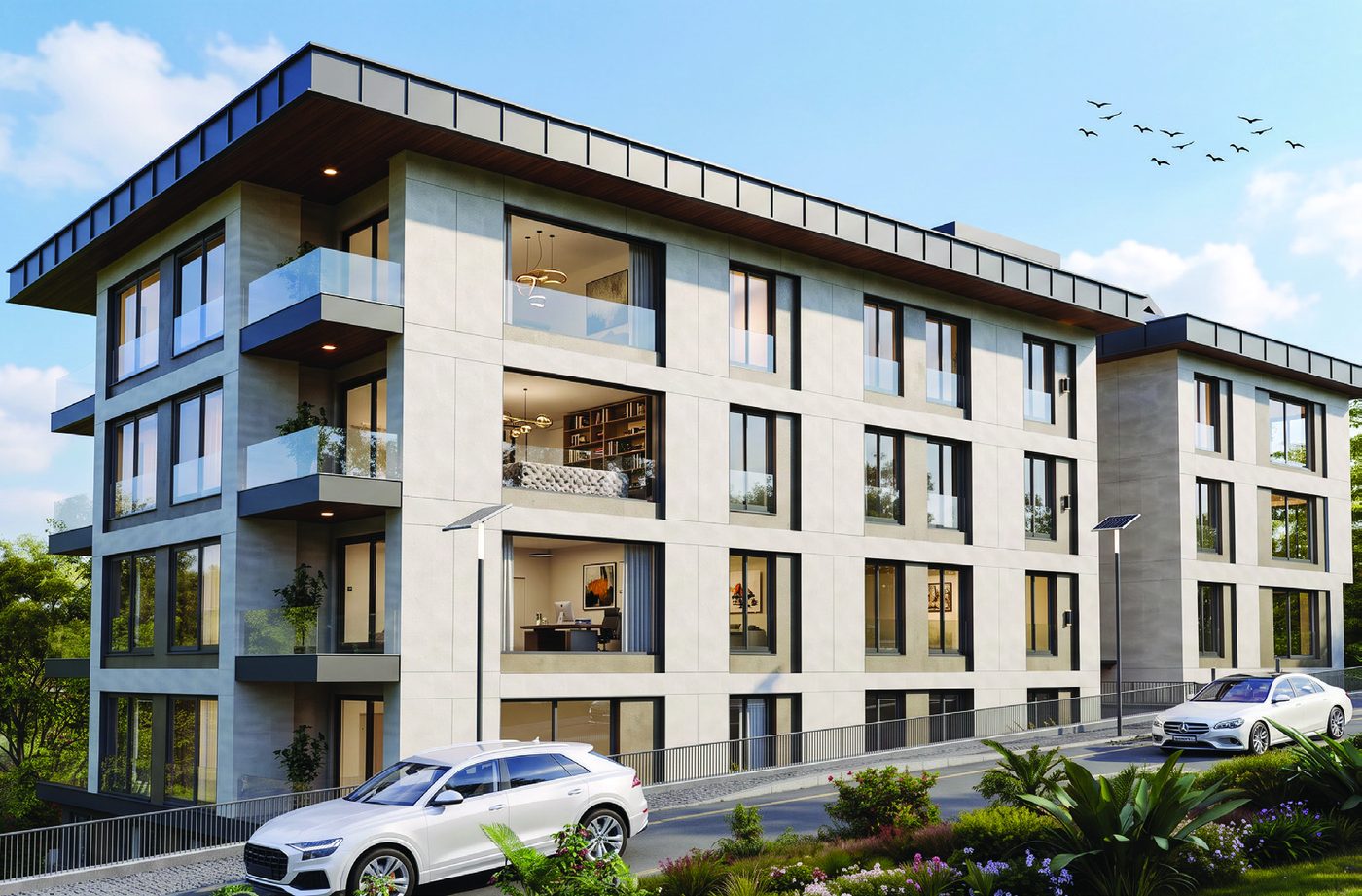
With projects by firms like ours that care deeply about architecture — that take into account the scale of the street, the angle of the sun and the texture of the neighbourhood — the avenue can modernise while keeping its identity. Bağdat Avenue is changing its shell; what matters is that the new shell is not empty inside.
What do property owners most want to know during a building’s transformation? What approach do you take in risk analysis, financing, the project process and handover?
Owners’ biggest concerns are, rightly, “trust” and “transparency”. They come with questions like “Will my building be left unfinished?”, “Will hidden costs come up?” or “How will the process work legally?”. At REMA Yapı we see property owners not as customers but as project partners. We manage every process under Law No. 6306 from end to end, taking on every step from core sampling and risky-building assessment to municipal procedures and legal risk analysis. As in all our projects, during the contract and protocol stages we always put transparent engineering data and workable financing and commitment models on the table. All the owners have to do is wait to receive the keys to their new homes with confidence.
What changes do you see in the expectations of the new generation of home buyers? Which stand out: larger floor area, social spaces, smart home systems, energy efficiency or shared living areas?
Buyers used to ask first “How many square metres?”. Today, right next to it, comes a very strong second question: “How were the soil survey and structural design done?”. Floor area still matters, of course, but earthquake safety is now on the table as a fundamental, indisputable priority, just like size and aesthetics.
Next comes efficiency of use. Instead of huge halls or rooms that go unused, people want compact, functional, energy-efficient homes with well-planned square metres and smart storage. With living habits changed since the pandemic, a good balcony, landscaping you can breathe in and infrastructure suited to working from home (smart home features and strong insulation) are also among the leading expectations.
Your projects include examples in different parts of Kadıköy such as Göztepe, Suadiye, Caddebostan, Kalamış and Feneryolu. How much does each area’s unique character shape your designs?
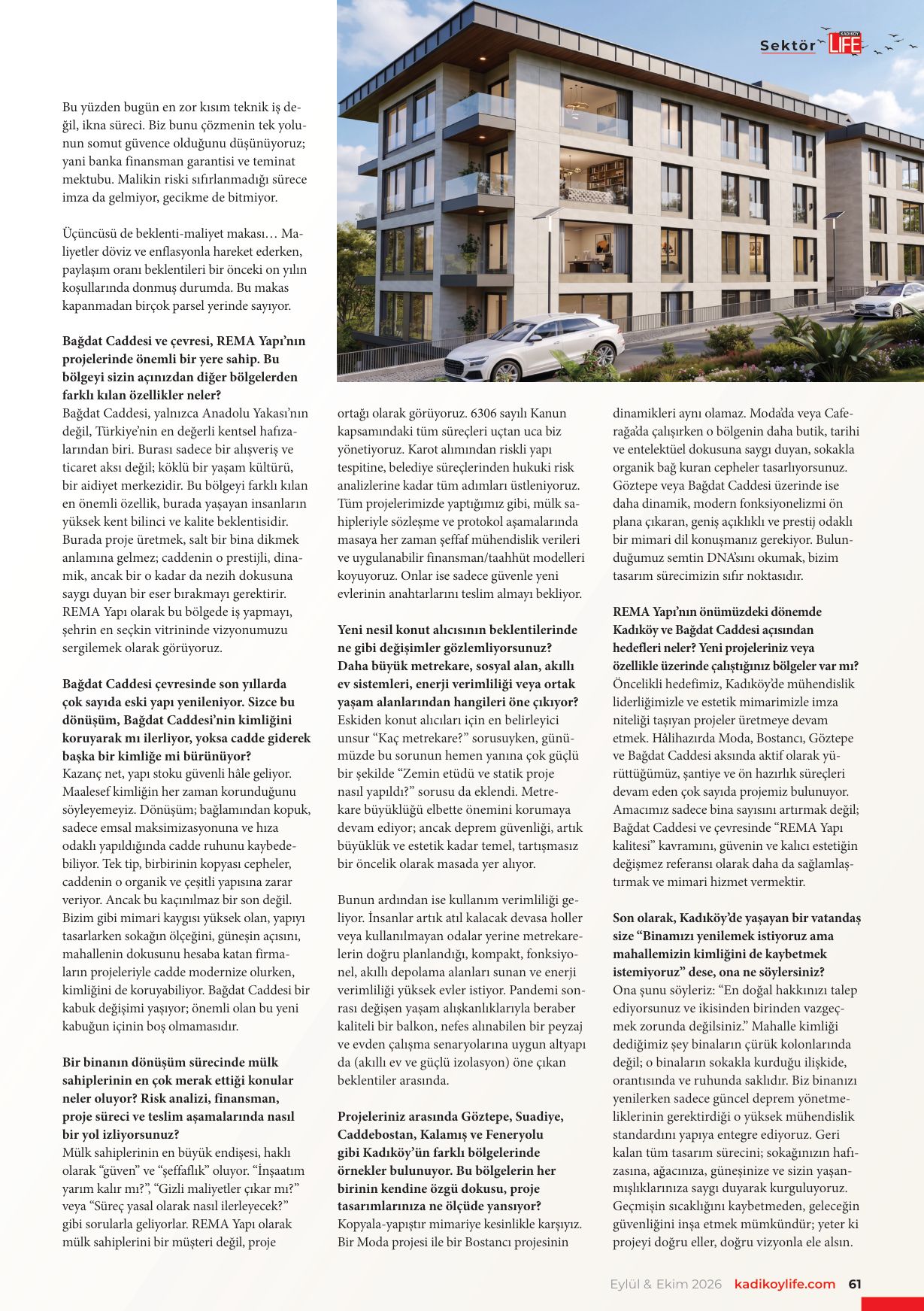
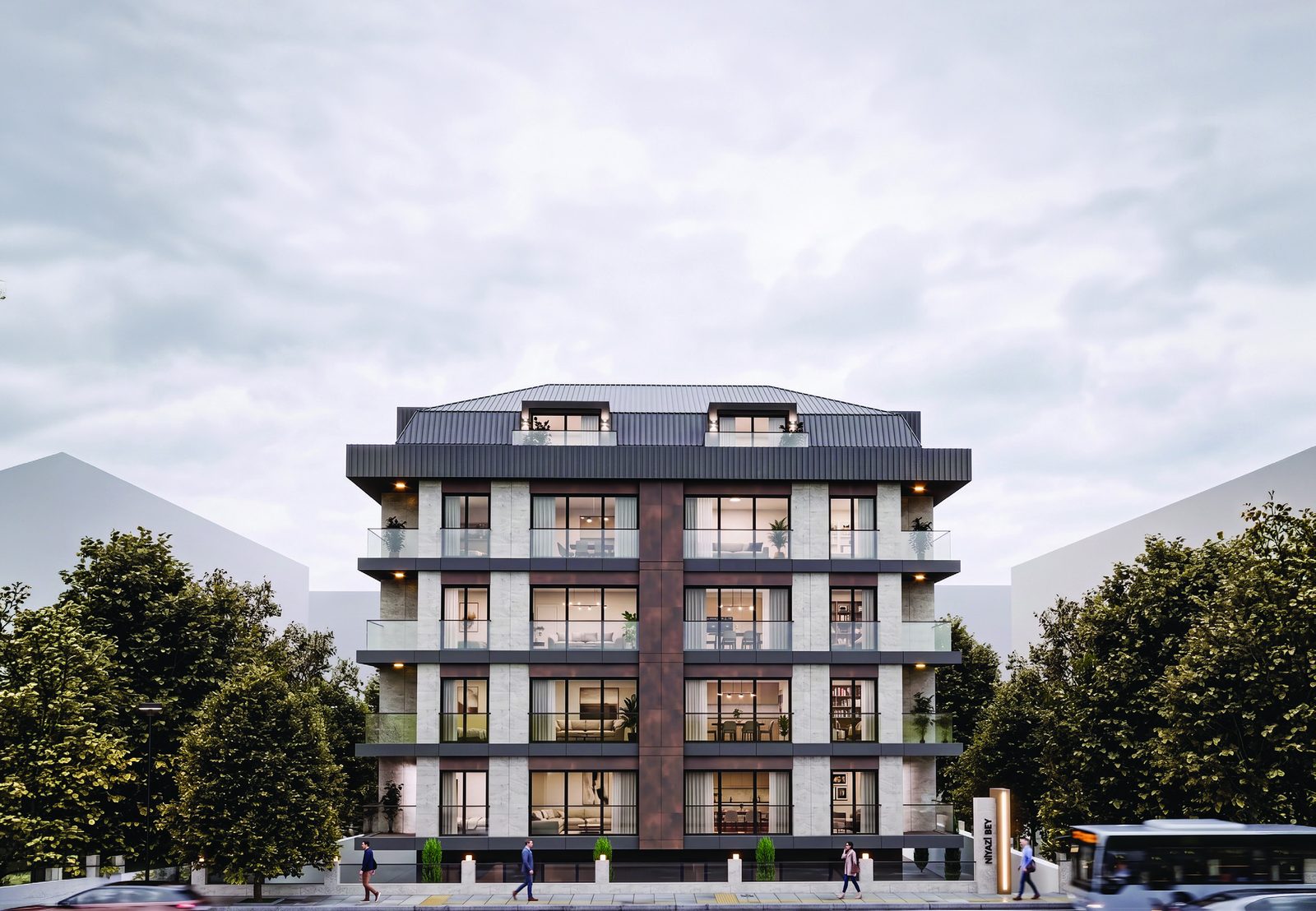
We are firmly against copy-paste architecture. A project in Moda and one in Bostancı cannot share the same dynamics. In Moda or Caferağa, you design façades that respect the area’s more boutique, historic and intellectual fabric and form an organic bond with the street. On Göztepe or Bağdat Avenue, you need to speak a more dynamic architectural language that puts modern functionalism first, with wide openings and a focus on prestige. Reading the DNA of the neighbourhood is the starting point of our design process.
What are REMA Yapı’s goals for Kadıköy and Bağdat Avenue in the coming period? Are there new projects or areas you are focusing on?
Our main goal is to keep producing signature projects in Kadıköy through our engineering leadership and aesthetic architecture. We currently have many projects underway along Moda, Bostancı, Göztepe and the Bağdat Avenue axis, either on site or in preparation. Our aim is not just to increase the number of buildings, but to further establish the idea of “REMA Yapı quality” as the constant reference for trust and lasting aesthetics around Bağdat Avenue, and to provide architectural services.
Finally, if a Kadıköy resident told you “We want to renew our building, but we don’t want to lose our neighbourhood’s identity”, what would you say?
We would tell them: “You are asking for your most natural right, and you don’t have to give up either one.” What we call a neighbourhood’s identity does not live in a building’s decaying columns; it lives in the building’s relationship with the street, its proportions and its spirit. When renewing your building, we integrate the high engineering standard required by current earthquake regulations. We shape the rest of the design process with respect for your street’s memory, your trees, your sunlight and your lived experiences. It is possible to build the safety of the future without losing the warmth of the past — as long as the project is in the right hands, with the right vision.